On the 360 Earthbelt Rulers
No matter how far we look back into the past, the lore of fate and the lore of the stars appear inextricably interwoven. Since ancient times, people have tried to glean knowledge about the present and the future on our planet from the visible positions, configurations, and movements of the lights in the night sky.
In the first century CE, the poet Marcus Manilius composed the astrological teaching poem Astronomica; in the third century CE we encounter the writings of Teucer of Babylon; and later still we learn from Rhetorios of Egypt, probably in the 6th–7th century CE, the last significant representative of the Hellenistic–Byzantine astrological tradition. What they share is a vision of the individual human being standing at the crossroads of celestial powers and the compulsions of fate. All of them ask how the decans — or, in further subdivision, clusters of degrees within the decans — shape a person’s character, life events, and destiny. All of them sought answers in the living architecture of the night sky as to why we are as we are, and why what befalls us, befalls us.[1]
All these observations and speculations concern one central question: how to express the unique qualities of the Ascendant with the greatest possible precision. For readers unfamiliar with astrological foundations, a concise synopsis may help: The ecliptic is the great circle that marks the apparent yearly path of the Sun against the background of the fixed stars. The Zodiac is that same line, divided into twelve 30 degree signs, 36 decans or faces, or even 360 degrees.[2] In classical astrology, the motions of the seven planets are likewise referred to the ecliptic — i.e. on the Zodiac — even though each planet’s path deviates above or below it as it completes its circuit. The point at which the ecliptic meets the eastern horizon at any given moment is called the Ascendant. It designates the exact zodiacal degree that is rising in the East — the degree through which any celestial body would appear to emerge into visibility.
The qualities of this rising degree can be articulated in several ways: by its position within the system of houses derived from the Ascendant itself; by the zodiac sign in which it is located; by any planets configured to that degree at the moment of rising; or by the fixed stars that lie close to its projected longitude. In the Hellenistic tradition, further refinements are added: its relation to the planetary ruler of the sign; the decan that contains it; and even the specific character attributed to the individual degree within a decan.
Manilius, Teucer, and Rhetorios each investigate different methods for grasping the Ascendant astrologically — for determining how the influx of qualities through this narrow eastern gateway may be expressed through the languages of signs, planets, decans, lots, and degrees. For they agree on one principle above all: that this point, the Ascendant, more than any other, reveals the fate, temperament, and life-course of the person born at that moment.
Magicians have always harbored the rebellious habit of repurposing systems meant to describe reality, to reshape reality instead. What academics devised for observation, magicians seized and turned into surreptitious tools of autonomy.
Leaping from the first millennia of our era to the more recent past, we encounter Sigmund Freud investigating psychological trauma to illuminate present behavior. Meanwhile, Austin Osman Spare set about developing techniques for deliberately implanting new traumas in himself — forgotten thoughts whose daimonic potency unleashes away from conscious oversight and control. What appears to one person as wound appears to another as entrance.
In our present case, it is hardly surprising that what Manilius, Teucer, and Rhetorios described as a cartography of human–astrological constitution was early on taken by magicians as an invitation to undertake autonomous journeys across that very map. The underlying logic was simple: if every degree on the Zodiac is so immensely powerful that it embodies a specific facet of fate itself, why leave it at the fact that we have each been touched by only one of these 360 points at the moment of birth? Why not add further touches? Why not invoke these 360 degrees of the ecliptic at will, summon again the conditions of our nativity, and in doing so expand, enrich, or alter our own course of fate — in accordance with our will and aspiration?
In astrological literature, we encounter the term moirogenesis.[3] In short, it refers to the creation of fate. The term was coined to describe the very passage through various degrees along the Ascendant and their distinctive influence on the person born at that moment. From a magical perspective, the word is equally applicable, yet here the emphasis shifts from passive experience to active invocation, participation, and co-cration. Moirogenesis in the magical sense thus denotes the calling forth of any — or multiple — of the 360 degrees of the ecliptic in order to engage fruitfully with their influences. Exploring the history and intricacies of this practice could fill an entire book. Our aim here is simply to provide enough of the historical-astrological context to support the following practice. For that purpose, I need to introduce one more piece of the historical puzzle — before shifting to emic goêtic language to explain the procedure in a way that enables sensory participation.
Around the same time that Austin Osman Spare was developing his sigil magic in England, the apocryphal German magician Friedrich Wilhelm, aka Rah-Omir, Quintscher (1883-1945) — whose name remains shrouded more in mystery than in reliable scholarship — was composing his own system of magical moirogenesis.[4] To what extent he drew on historical sources remains ambiguous; according to his own account, most of the notes he produced, some of them written in the trenches of the First World War, were dictated by the “Voice of Silence.”[5] What we can say with certainty, however, is that it was Quintscher’s privately circulated manuscripts and personal conversations with him that later inspired Franz Bardon (1909-1958) to undertake his own magical exploration of the 360 degrees of the ecliptic.[6] Both researchers must have had access to a copy of the well-known book of Abramelin for their studies — for Quintscher likely as a stimulus for developing his own system, and for Bardon clearly as a source for adoption and expansion of Abramelin’s original cartography of daimonic rulers.[7]
A precise description, comparison, and commentary on the systems of Abramelin, Quintscher, and Bardon must be left to the separate book mentioned above. Here, the focus is on practical application, and even this will be approached only in a condensed form for the purposes at hand. Before we can proceed, I would like to conclude this excursus with a brief description of the 360 genii as they have revealed themselves to me through my own practice. The value of this introduction from the inner perspective of a practicing magician is, of course, subjective; it is intended, however, to make the system more relatable from the inside, to move it from abstract-astrological diagrams onto the bridge of personal experience.
So, let’s go.
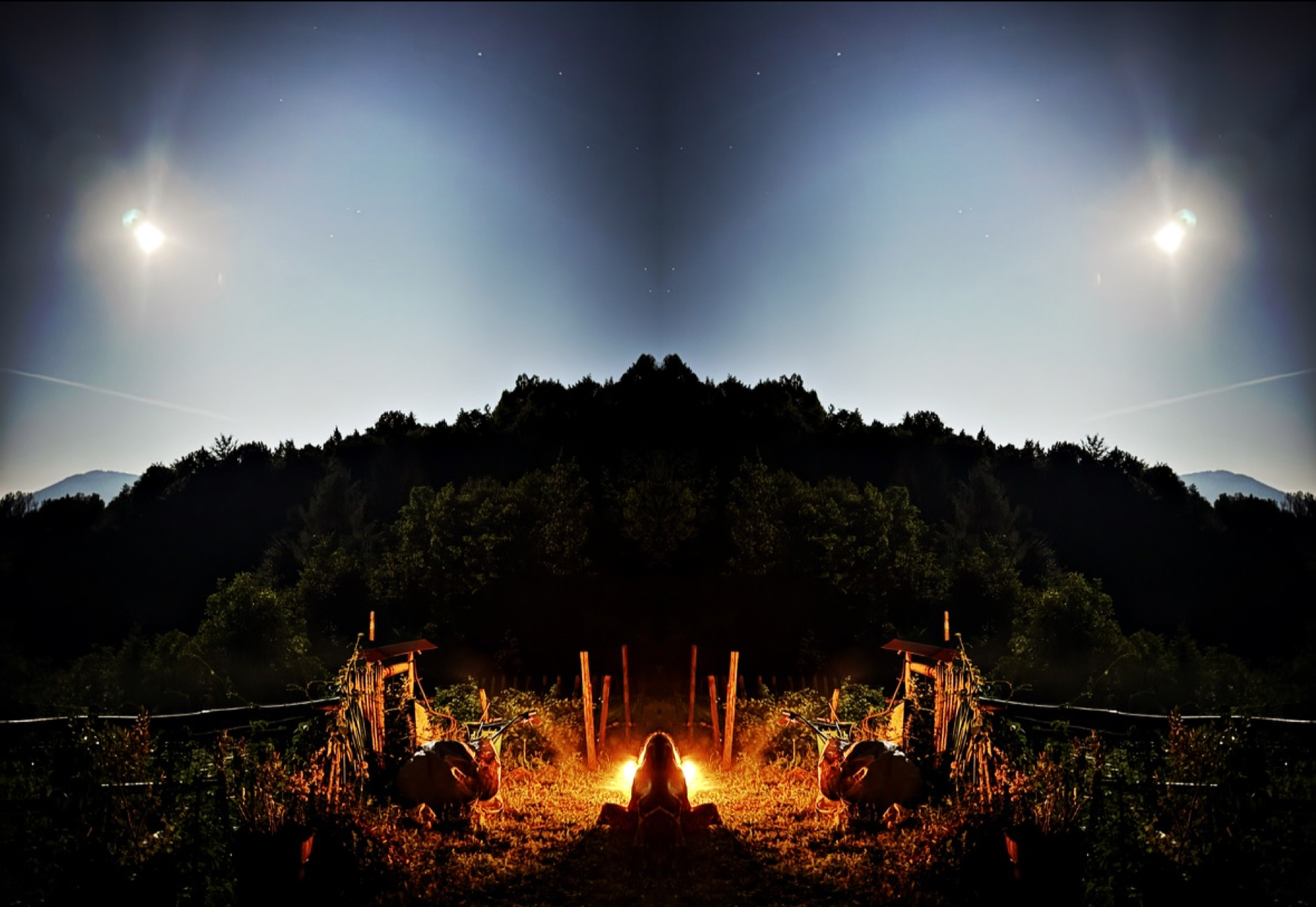
Imagine the Earth at the very center of a vast, invisible globe. This globe isn’t a solid shell but an imagined sphere that perfectly follows the Moon’s orbit around the Earth. Every point on the surface of this sphere corresponds to a position that the Moon occupies at some moment in its monthly journey.
Now go on to imagine that this sphere bears a belt, a band encircling it. This band is the ecliptic, and like any belt, it serves a simple function: it binds, contains, and separates the sphere beneath the Moon from the open, black celestial expanse above it. Further, let us imagine that this belt contains 360 openings. As it revolves around the Earth, the rising Sun at the eastern horizon appears over the course of a year, in turn, through each of these openings, casting its light — colored by the qualities of that point on the Earth‑belt — down upon us.
Here comes the magical part. Imagine that each of these 360 openings holds a mask. Each mask faces downward toward the Earth; that is, its facial side is directed toward us, while its open back is turned away. Thus, 360 masks — or magical genii — look down upon the Earth. Each is animated by the unique astrological influences of the fixed stars and constellations that, in turn, appear behind that mask at the moment it rises at the Ascendant, at the eastern horizon. From our earthly perspective, we see each of these 360 masks as divinely enlivened. They speak to us, observe us, and extend their aid.
If one were to rise to the height of the Moon and higher, gazing down upon the ring of masks from above, one would see that they are all hollow—that is, open vessels of celestial light.
These are the 360 genii of the Earth‑belt zone: living lenses of cosmic powers.[8] Bardon consolidated them into a practical system of applied magic, Emil Stejnar made them more accessible in his Thebaic Calendar,[9] and their names are scattered throughout the third book of Abramelin.[10] Working with them is distinguished by the fact that they understand the human condition. They see us not merely as divine sparks but also comprehend our embodied limitations and constraints. Each offers unique qualities to support and guide us along our life path. Some are bound to us in heart and flesh, having touched us at the moment of our birth; others may be approached for the first time later in life, when we call them magically and invite them into active, positive participation in our lives.
Once the ritually working magician has perfectly mastered the beings of the elements, he can advance his magical work and begin his research into the sphere that is closest to him. The nearest sphere is the earthbeltzone; i.e. the spiritual-astral plane of our planet. Within this plane there a manifold of being exists with all of whom the magician can come into contact in order to broaden their knowledge and widen their power.[11]
Footnotes
[1] Dorian Gieseler Greenbaum, The Daimon in Hellenistic Astrology: Origins and Influence, Leiden: Brill, 2016, p. 227
[2] On the question of whether the Paranatellonta were described for all 360 degrees of the ecliptic in antiquity, I refer to the important work of Franz Johannes Boll. (Franz Johannes Boll, Sphaera – Neue Griechische Texte und Untersuchungen zur Geschichte der Sternbilder, Leipzig: B.G. Teubner, 1903, p. 430). For an even more advanced in depth exploration, including original sources in Greek, Latin and French, I recommend Wolfgang Hübner, Grade und Gradbezirke der Tierkreiszeichen, 2 volumes, Leipzig: B.G. Teubner, 1995.
[3] From Greek moira (“fate, portion, destiny”) and -genesis (“creation, origin”). In classical astrology, the process by which specific degrees of the zodiac, especially along the Ascendant, exert their unique influence on an individual’s character, life events, and fate at the moment of birth. A related term is the above mentioned Paranatellonta; a word derived from para (“beside”) and anatellō’ (“to rise”). It’s used to describe associated stars or constellations that share the rising time of a specific zodiacal degree, often thought to influence or color the events or character associated with that degree.
[4] Friedrich Wilhelm Quintscher, Das Hauptbuch der Wissenschaft des Geistes, 2 Bände, Graz: Edition Geheimes Wissen, 2020
[5] Volker Lechler, Die ersten Jahre der Fraternitas Saturni, Baustein zum okkulten Logenwesen Band 2, Stuttgart: Verlag Volker Lechler, 2015, p. 190
[6] Franz Bardon, Die Praxis der magischen Evokation. Anleitung zur Anrufung von Wesen uns umgebender Sphären, Freiburg im Breisgau: Hermann Bauer Verlag, 1956
[7] Bardon arranged the genii according to the sequence of the twelve zodiac signs, beginning with the first degree of each sign and ending with the thirtieth. Abraham of Worms, by contrast, describes the 360 rulers in a different order: he groups together all twelve first degrees of each sign, then all twelve second degrees, and so on. This is not without reason, for, as I was later explained by the entities themselves, there exists a specific relationship between the individual degree rulers within each sign. (Frater Erec, Bardons Genien und die Abramelin-Magie, von einem der Hermetischen Vier, in: Abraham von Worms, Das Buch der wahren Praktik in der uralten göttlichen Magie, Urquellen Inneren Lebens zum Heile der Welt neu kundgegeben von einem Collegium Pansophicum, Ein Archiv in zwangloser Folge, Archiv Hermetischer Texte, Band 12, s.l.: s.n., s.a., p.41)
[8] For those wishing to distinguish with even greater precision, it should be noted that, in Bardon’s system, the Earthbelt zone technically lies below the sphere of the Moon. For our purposes here, this is of less importance, as we are concerned only with the rulers of the Earthbelt zone, whose astrological ‘homes’ are along the ring of it its outer, upper periphery. Naturally, these beings move freely throughout the entire sublunar realm once invoked and engaged in magical contact.
[9] Emil Stejnar, Der Thebaische Kalender - Die 360 Genien der Erdgürtelzone, die Zeit ihrer Macht und die Praxis der mystischen Invokation, Wien: ibera, 2012
[10] Rick-Arne Kollatsch (ed.), Des Abraham von Worms Buch der wahren Praktik von der alten Magie - Ein als jüdisch fingierter Magietext des frühen 17. Jahrhunderts, Band 1 - Edition, s.l.: s.n., 2021
[11] Franz Bardon, Die Praxis der magischen Evokation, Wuppertal: Rüggeberg Verlag, 2002 p.184, translation by author.